Thumbnailing and Iterative Studies for Composition
Why thumbnails first
Thumbnailing is the fastest way to test ideas, silhouette, and focal relationships without committing to detail. Iterative studies amplify the benefit by repeating short cycles of adjustment and reflection. Together they form a reliable path from concept to confident composition.
Set a simple thumbnail habit
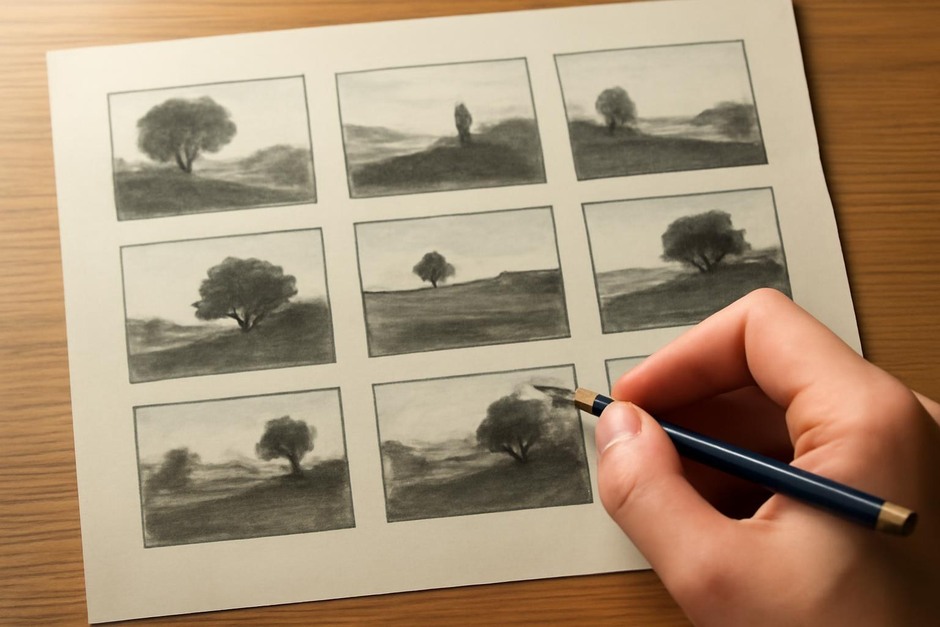
Create a document with a grid of small thumbnail boxes. Each cell should be compact — roughly the size of a postage stamp on screen — so you focus on big shapes. Work on 10 to 20 thumbnails in 15 to 25 minutes. Limit yourself to three marks per thumbnail: silhouette, primary light shape, and a focal point.
Iterative study cycle
- Choose three promising thumbnails. From your thumbnail set, pick three that solve different problems: one with strong silhouette, one with interesting perspective, and one with a clear focal push.
- Develop each as a 15-minute study. For each thumbnail, block in value and refine the silhouette. Make one decisive change per iteration: flip the focal placement, tighten a shape, or simplify an edge. Record the change so you can compare iterations.
- Reflect and retarget. After completing three studies, note which choices improved clarity and which created new problems. Use that insight to run another short thumbnail session focused on the new constraints.
Practical exercises
- Negative space challenge: Create thumbnails that explore interesting negative spaces. Turn the negative space into a compositional element until it reads clearly.
- Limited focal shift: Make five thumbnails that only vary the placement of the focal point while keeping silhouettes similar. Observe how small moves change the reading of the image.
- One-shape narrative: Use a single dominant shape in several thumbnails and build different narratives around it by varying supporting shapes and values.
Creating a routine
Integrate thumbnailing into the start of each project session. A routine might be: 10 minutes of thumbnails, 30 minutes of three iterative studies, and 10 minutes of reflection. Keep a dated folder of thumbnail sheets and short notes. Over time you will recognize recurring compositional solutions and patterns you prefer.
Thumbnailing and iterative studies are exercises in controlled constraints. By limiting time and tools, you make composition a matter of decisions rather than decoration. The regular practice trains you to see the skeleton of an image quickly and to refine it through short, focused iterations.